
Architecture
Architectural design
User experience design
If you asked me 5 years ago, "what is UX design?", I wouldn't have known what you were talking about. Although it's an industry that has been around for some time now, I only learned of it's significance through chance encounters with some individuals who are practicing UX Designers. Some of them also happened to work as Architects. Through speaking with these people, and conducting my own research of what UX design entailed, I quickly understood that there was much in common between the two industries.
From my education in architectural school to my experience in professional practice, I have developed a strong foundation of design skills that I believe carry through to a user experience design career.

Architectural design
User experience design
From my education in architectural school to my experience in professional practice, I have developed a strong foundation of design skills that I believe carry through to a user experience design career.
From my education in architectural school to my experience in professional practice, I have developed a strong foundation of design skills that I believe carry through to a user experience design career.


Focus on end-user
The experience of place
In 2019 I developed a research project called 'The Experience of Place through Movement' which explored the concepts of place-making and how it could be enhanced through a more active engagement by the end user, through the act of movement.
"In modern cities throughout the world our sense of orientation, knowing where and who we are, is now perhaps damagingly compromised. Offices, apartments, and stores are piled together in ways which owe more to filing-cabinet systems or the price of land than to a concern for human existence or experience."
Bloomer & Moore, 'Body, Memory, and Architecture', 1977
The relationship between human identity and place identity has perhaps been lost today. Human identity, our ability to reflect on ourselves and understand who and where we are, is what conditions place identity. Globalisation has led to an architecture of uniformity, which could be described as identical and even dull. It prioritises the furniture and fittings of a space, and not the human experience within it.
Similarly, with social media so prevalent in our daily lives, our own personal and national identities are becoming blurred along with the rest of the world. In order to discover the richness of our own environment, people should be more aware of their built environment and enjoy the physical act of being present in their world, and the uniqueness of the spaces around them.
The below project was an opportunity to demonstrate that the act of dwelling can occur not only by experiencing space from a static perspective, but also that we can learn so much more by moving through an environment, prompting us to dwell more poetically within a place.

The site I selected to test this thesis was an area situated in the Wicklow Mountains National Park, where the Irish Astronomy Society visit once a month to stargaze. There is currently no dedicated facility for them and an accessible, public outreach astronomical facility would make the night sky more accessible to the residents of the greater Dublin area.
An observatory here
...and a planetarium here

Site map of Lough Dan
Lough Dan is a place that is rich in history and nature. The area is dotted with the remnants of famine settlements which have since become ruin. These ruins sit into a beautiful landscape where herds of wild deer graze.
The astronomical facility is split into two parts; an observatory and a public planetarium. To explore my idea of movement through place, I wanted to create a journey that would take the observer from the planetarium, across this landscape to the observatory. The journey would allow for someone to experience the many layers of the place and hopefully how their own identity resonates with this journey.
Part 1: The planetarium
The main inspiration behind my design was the experience of a journey, feeling the sense of arrival and departure. These were the qualities I believed would allow someone to become self-aware of their body and its position within the landscape and the world.
The first experience of the place is looking down at the planetarium from a hilltop (see image right). A series of ramps zig-zag their way from the road down to the building. These would be constructed in such a way that they begin to cut deeper and deeper into the hill as they progress. This creates a sense of compression as you move down to the planetarium, the walls around you rising slowly over your head, focusing your movement before releasing you back into the open space surrounding the planetarium.

Users first view of the planetarium
A timber frame belvedere sits over the zinc-clad planetarium, which is accessed by an external walkway which projects as an elbow to the building, first ramping out to a landing which provides a raised view looking up the river towards Lough Tay, before turning the user back towards the building up a set of stairs.
The stairs lead to a sheltered outdoor space, darker than the outdoor environment. It is naturally lit through several hundred keyhole pentrations in the timber cladding, creating a starry night effect dappling across all internal surfaces. On the outside, these make up constellations which are etched into the timber.

Users view walking up the inside of the timber belverdere over the planetarium
Rendered using Lumion

Section shows how user view surrounding landscape framed by opening
A series of stairs run around the internal edge of this space, suspended by delicate steel hangers. This vertical movement up the belvedere had to connect the user to the place, so on each level there is an aperture which frames views of different elements of the area. This vertical movement up through the space creates a sense of compression as the stairs and landings become slowly narrower the higher one gets, before finally being released onto the roof terrace and back into the open. A panoramic view allows the user to see each of the natural aspects which they observed on their way up and how each connects to the other. A strong mental image is formed allowing the visitor to have a more resolved understanding of the entirety of the place that they are in.

User's perspective (as per the above section), framing the horizon
Collage of hand drawn and digital elements combined in Photoshop
Part 2: The observatory
The observatory is composed of several elements - the observation court, a linking corridor which is suspended between two timber structures which house the private observatory facilities. The observation court is the main public space for viewing the sky. The square courtyard is filled with a white quartz stone gravel surface, a stone which is abundant in the Wicklow Mountains, demarcating the space which is associated ot the site, and is the same stone which is used in Newgrange, a site famous for connecting humans with the astronomical.
In connecting this building to this place, the most important element was not only about having an understanding of the surrounding landscape but also focusing the view to the night sky. A large circular opening in centred over the space allows for a total appreciation of an unobstructed view of the night sky above. This is where the user's journey of place would end. Their movement across this landscape has allowed them to experience the historical landscape from the intimate valley, to here, where the could finally appreciate the expanse of the cosmos.

User's perspective standing with the observation court of the observatory
Collage of hand drawn and digital elements combined in Photoshop
An eye for detail
Attention to all elements, no matter the scale
Studying and working in architecture has significantly honed my attention to detail, a skill that I'm eager to leverage in the field of UX design. Architecture demands meticulous precision in every stage of the design process, from conceptualisation to execution.
In architecture, overlooking even the smallest detail can lead to significant consequences, whether aesthetic, functional, or safety-related. This ingrained mindset has trained me to approach projects with a meticulous eye, scrutinising every element to ensure cohesiveness and excellence.
S
M
Transferring this attention to detail to the field of UX design offers a unique advantage. Just as in architecture, the success of a digital product hinges on the seamless integration of various components. From user interface elements to interactive features, every aspect must align harmoniously to deliver an exceptional user experience. My architetcural background equips me to navigate complex design challenges methodically, ensuring that no detail is overlooked in crafting intuitive and user-centric designs.
By merging the precision cultivated in architecture with the creative problem-solving inherent in UX design, I am poised to deliver innovative solutions that resonate with users and elevate the digital landscape.
L
XL
Small
This portable reading room was designed by my partner and I to accommodate users who passed through our local park to sit and read while offering shelter from the elements (rain being an all too common issue in Ireland).
The small scale of the scheme allowed us to investigate all elements of the design, from how it was transported, how it opened and closed, and how users could interact with it.
The overall intent was to create something playful, with sliding bookshelves and seating compartments, to allow people to sit together or have a moment of privacy.


The portable library pod in its closed state

Hook to hang up your wet umbrella, and a porous shelf which drained out the backside of the pod.
A bird feeder could be hung from the same hook & eye latch that is used for closing the swing door
User sitting in the portable library pod
Medium
The scale we most often find ourselves in, designing spaces that are meant for moving through and living within. In 2018, I met with the owners of 'Life in Motion', a bicycle shop based in Dublin, to discuss how the shop could be improved in several ways. The space had a lot potential, but it was quite restrictive to move around in, which meant customers (the users) were finding it difficult to operate within, bringing their bicycles in and out for repairs. This was critical area which needed to be addressed.


Hover over to see proposed scheme
'Life in Motion' bicycle shop - existing & proposed sections
The first thing done was to remove the central lobby wall and open up the space so customers would immediately find themselves within the display room. Not only was the space now more open, the shop was able to show off their new inventory more easily.
The backwall into the storage room was removed, to allow for the mechanics workshop to be extended, and also to allow for more natural light which the space was previously lacking. The rear glass wall shows off the outdoor wash area, which highlights this service which was not previously available to customers who may like their bikes cleaned.
Large
I was on a team tasked with creating a new urban hub in Harold's Cross, Dublin. Our proposal sought to question the present culture of repetitive low-density housing typologies in inner suburban Dublin. We took a clear stance that the shortfall of housing density and active public space can be addressed by placing a focus on public green space challenging inactive back garden spaces.
By creating high-density, low-rise housing of varied types from 4-bedroom family homes, studio units and 1-2 bedroom apartments, this would draw a wider demographic into these suburban greens, activating them throughout the day which achieving desirable high-density living at the edge of the city. Community and social programs, such as a creche, youth club, working units, and a pavilion were carefully distributed throughout the scheme to feed character into the suburban public squares in the project.

Proposed masterplan model of 'Mount Tallant Place'

User's view of shared public spaces

Green areas to meet friends

A central pavilion tower orientates users throughout
Extra Large
The above project was one piece of a puzzle for an overall masterplan of Harold's Cross, a suburban area of Dublin City. As a collective, we set out to envision a new masterplan for Harold's Cross and following this developed some of the proposals as design projects.
Throughout the project, we interacted with the local community as a client base, through conversation, design reviews, and exhibitions. I routinely met with residents to discuss the challenges they faced in their area, what they liked most about the neighbourhood, and what things they would most like to see in their locality.

Meeting with the community to discuss proposals


Harold's Cross masterplan model
The engagement with the community was critical, and without their input, our designs would have had no foundation to stand on. The final scheme was received very positively, and was proudly displayed in Harold's Cross as part of the Harold's Cross Community Festival in 2018.
Presenting my design schemes to the public
Adjusting to client demands
From libraries to radar infrastructure
In my years of professional experience working within architecture, I have been fortunate to have been involved in a wide variety of projects at various levels. This has sharpened by ability to adapt swiftly to diverse client types and their unique demands, spanning from public libraries to historic Georgian homes, modern apartment blocks, and even radar facilities.
Each project neccesitates a tailored approach, considering not just the aesthetic and functional requirements but also the specific needs and preferences of the client. This experience has cultivated my flexibility and agility in designing for various sectors, ensuring that I can seamlessly transition between different contexts and deliver solutions that resonate with distinct user groups.

Proposed Ringsend Library (DMOD Architects)

Proposed apartment scheme in Glasthule (DMOD Architects)

Completed home in Wicklow Town (DMOD Architects)
This adaptability translates seamlessly into the realm of UX design. Just as in architecture, crafting user experiences necessitates a keen sensitivity to different user demographics and their unique needs. Moreover, my experience in architecture has honed my ability to translate abstract concepts into tangible, functional solutions. Whether conceptualising a building layout or a digital interface, the process requires creative problem-solving and effective communication with stakeholders.

Radar infrastructure completed in Dublin (DMOD Architects)
Collaborative processes
It's a team effort
My journey through architecture has profoundly enriched my ability to thrive in collaborative environments, essential for navigating the complex and interdisciplinary nature of design projects. In architecture, success often hinges on the ability to work harmoniously with diverse team members, including architects, engineers, clients, and contractors, to bring a collective vision to fruition. Through countless collaborative endeavours, I've developed the capacity to communicate effectively, actively listen to others' perspectives, and synergize diverse ideas to achieve shared goals.
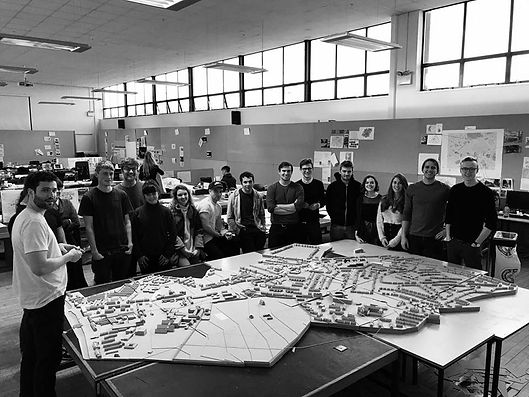
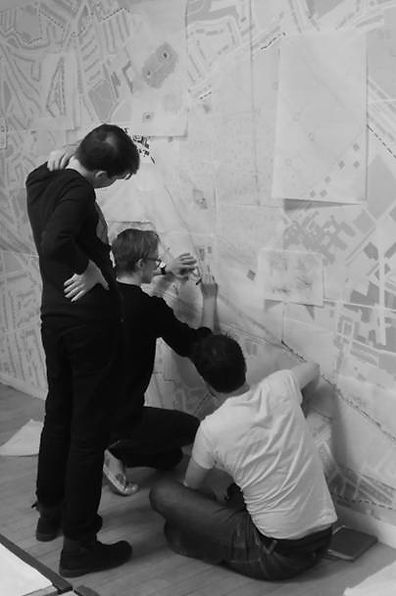
Just as in architecture, creating compelling digital experiences requires a multifaceted approach that integrates insights from various disciplines and stakeholders. Drawing from my background, I excel in fostering an inclusive team environment, where each member's expertise is valued, and ideas are openly shared and refined. I hope to use my adeptness in teamwork and collaboartion in UX design to create projects that unite diverse perspectives, drive innovation, and ultimately deliver exceptional user experiences.